Select shipping country

In order to provide you with the final prices of the products (including taxes and transport costs), we need you to select the country of destination from the following list of countries.

On 1 July 2021 the One-Stop Shop (OSS) directive for e-commerce came into force. This will require us to apply the V.A.T. rate corresponding to the destination country of the shipment.

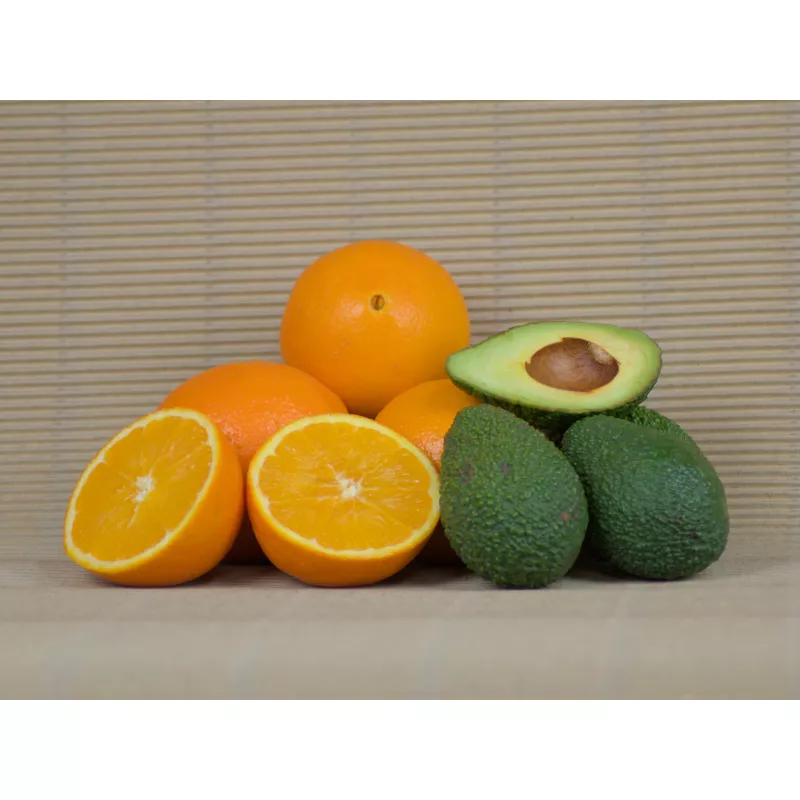
Organic Mixed Box 20 kg (18 kg oranges + 2 kg avocados)

Navelina/Hass Organic Farming Out Of Stock
78.00 3.90 €/kg

Oranges Navelina

Origin

The Navelina variety is a spontaneous mutation of the Washington Navel orange originating in Riverside (California) around 1910, initially known as Smith’s Early Navel. In 1933 it was sent as plant material to the IVIA in the Valencian Community, where it was given the name Navelina because of its slightly smaller size than Washington Navel. Its commercial propagation began in the 1960s, with significant expansion during the 1970s, establishing itself as one of the most widely cultivated Navel varieties in Spain.

Characteristics

Vigorous tree, rather compact in habit, thornless and with dark-colored foliage. It presents pollen-free flowers, typical of the Navel group. The fruit is round, slightly oblate, with a diameter between 73-78 mm, and a diameter/height ratio close to 0.98. Average weight ranges between 200-220 g. Medium-thickness peel (3.5-4.5 mm), intense orange color, color index 18. Very juicy pulp, seedless, with a typical number of segments between 10-12. As for internal quality, the Brix degrees are around 10-12º, with moderate acidity (around 0.9-1.0 % citric acid), juice content between 50-54 % of the fruit.

Harvest period

In the Valencian Community, harvesting begins approximately between October 20 and 30 and extends until the end of January. It is early-ripening compared to other Navel varieties, reaching the market earlier. It has a good ability to remain on the tree without losing quality during the first half of the harvest window; its optimal fresh-market window is in November and December, when it reaches its maximum internal quality and external color.

Culinary uses

It is mainly intended for fresh consumption, as a table orange, due to its ease of peeling, sweet flavor and seedless pulp. It can also be used for juice, although it is not its preferred use for the industry, since other varieties provide higher juice yield. In Mediterranean cuisine it is enjoyed as is, in fruit salads, salads or side dishes where its citrus aroma is appreciated; combinations with honey, fresh herbs (mint, thyme) or mild cheese are common.

Agronomic notes

High productivity and early bearing. It shows alternation between seasons, although moderate. Good tolerance to calcareous soils and iron chlorosis, and also some resistance to cold compared with other Navel varieties. Sensitive to rind blemish; peduncle attachment is good. It is recommended to graft onto rootstocks such as Carrizo citrange or C-35, which provide a good balance between vigor and fruit quality. Postharvest behavior is good if it is kept at temperatures between 6-8 °C; there are limitations in prolonged storage, since the flavor may change and delayed bitterness appears if the juice is used after a long storage period.

Avocados Hass

Origin

The Hass variety was discovered by horticulturist Rudolph Hass in La Habra Heights, California, in 1926. It was patented in the United States in 1935. Its origin focuses on a hybrid mostly between Guatemalan and Mexican races, with Guatemalan traits predominating. It does not come from a specific known mutation, but from a chance seed selection that resulted in a tree with fruits with rough skin, superior flavor and yield compared to the rest. Since its obtaining it has spread worldwide as the leading commercial variety.

Characteristics

The Hass tree reaches medium to vigorous size, with a semi-erect canopy and open branches. The leaves are petiolate, medium-sized, green and glossy. Flowering is type A. The fruit has a pear shape, medium size, approximately 140 to 400 grams, with thick, rough, green skin that darkens to black when ripe. The seed is medium to small in size, occupying around 15-16 % of the fruit weight. Creamy pulp, greenish-yellow in color near the pit, with a fiberless texture and intense flavor, with nutty notes. The lipid content ranges between 17-20 % under optimal conditions and the minimum commercial dry matter is established at around 21-23 %. Brix degrees at ripening usually range between 5 and 8 depending on origin and storage.

Harvest season

In the Comunitat Valenciana the Hass harvest begins approximately in December-January and can extend until March, although there are early or late occurrences depending on the specific area. The ripe fruit can remain on the tree for several days or even weeks without losing quality considerably, which allows harvesting to be staggered. The optimal window for fresh marketing runs from December-January to March, which is when the fruits meet good dry matter, color and texture ideal for the market.

Culinary uses

Hass is mainly suitable for fresh consumption due to its creamy texture and intense flavor, ideal for guacamole, toast, salads, dips and cold sauces. It is also eaten simply cut with salt or combined with citrus or tomato, very present in Mediterranean cuisine. Its pulp is also suitable for light processed products such as creams or purées, although it is not typically used for juice. Due to its flavor and texture, it is the preferred variety for applications where spreadability and fatty presence are sought.

Agronomic notes

Hass has good productivity but often shows alternation if not managed well. It is sensitive to extreme cold below 4-5 °C and to fungal diseases such as soil fungi or Botryosphaeriaceae in branches. In the Comunitat Valenciana the seedlings are established with moderate planting frames (for example 6×5 m) to allow ventilation and pruning. In postharvest it requires careful handling, cold chain, harvesting when it has the minimum dry matter content and use of official calibers. The main commercial limitations include fruit size comparatively smaller than some varieties, the need for a high percentage of dry matter, sensitivity to irrigation management and water stress, and increasing future pressure from competitors in other countries to maintain prices.

Organic Farming

These fruits come from a certified organic farming that respects the environment. Treatments are only applied when necessary and always with natural substances approved by the organic agriculture committee. Like all our products, they undergo no post-harvest treatment.

Different regional control bodies in Europe ensure that consumers receive truly organic products. The organization for our region is CAECV (Committee of Organic Agriculture of the Valencian Community), authorized by the European Union with code ES-ECO-020-CV.

78.00